
 Yes, you can get pregnant on your period. It is less likely than at other points in your cycle, but it is possible. Sperm can survive inside the reproductive tract for up to five days, so sex during the last days of bleeding can still overlap with ovulation if your cycle runs short.
This answer surprises a lot of people, because “you can’t get pregnant on your period” is one of the most repeated pieces of incorrect advice out there. Here is what actually determines whether it can happen, and what it means for you depending on whether you are trying to avoid pregnancy or trying for a baby.
How the fertile window works
According to the American College of Obstetricians and Gynecologists (ACOG), sperm can live in the body for as long as five days. An egg survives only about 12 to 24 hours after it is released. Put those together and you get a fertile window of roughly six days in each cycle: the five days before ovulation, plus ovulation day itself.
If your cycle is 28 days, ovulation lands around day 14 to 16. If your cycle is 22 days, it lands closer to day 8, which can be within a day or two of when bleeding stops.
Quick reference: Cycle day 1 is the first day of full bleeding, not the day spotting begins.
When pregnancy during a period is most likely
Three things push the odds up.
Short cycles. The average menstrual cycle is about 28 days, but ACOG notes that cycles anywhere from 21 to 45 days can be normal, and it can take six years or more after periods start for a cycle to settle into a pattern. On a 21-day cycle, ovulation can arrive around day 7.
Long periods. Bleeding for two to seven days is normal. If you bleed for seven days on a short cycle, the end of your period and the start of your fertile window can overlap directly.
Irregular cycles. If your cycle length swings by a week or more, there is no reliable way to predict ovulation from the calendar alone.
Here is how it plays out on a 28-day cycle with a 5-day period:
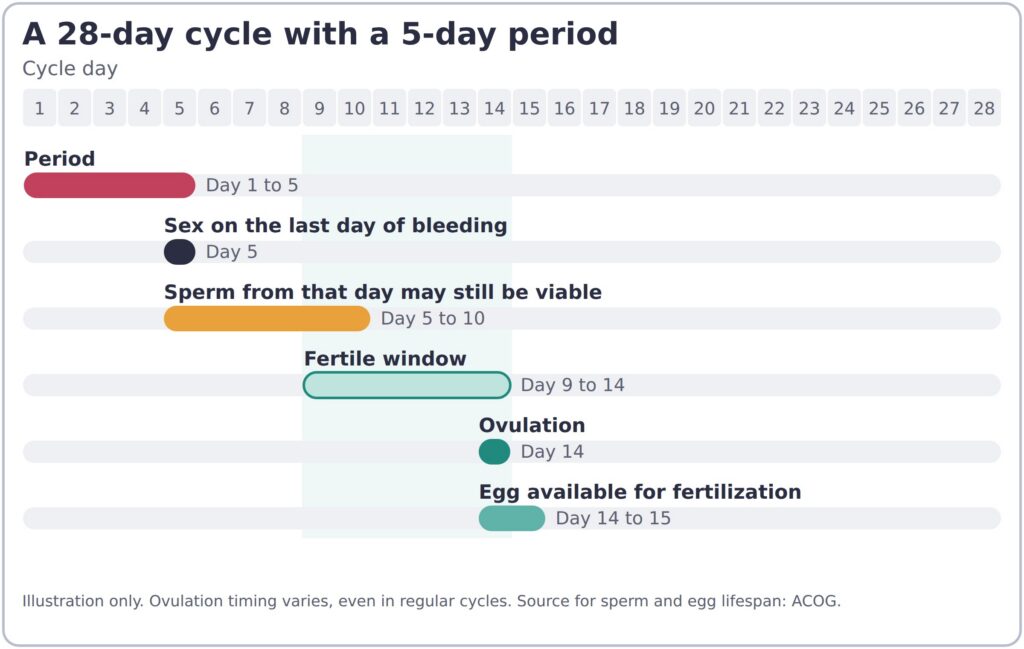
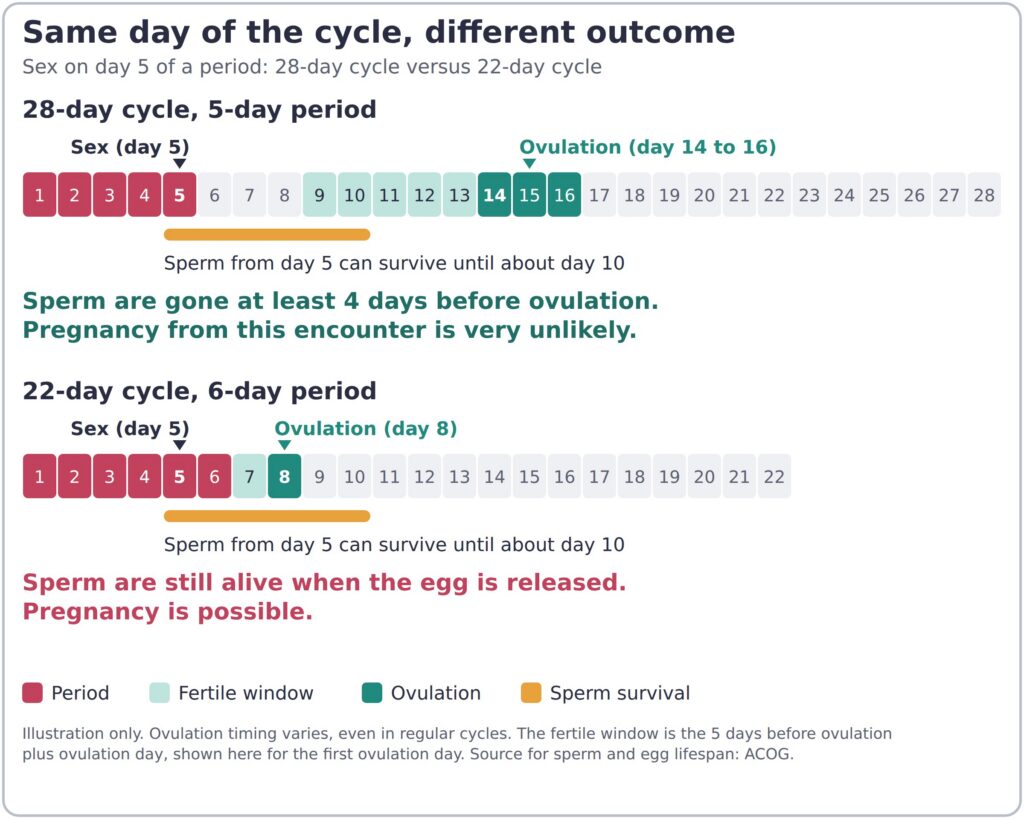
Sperm from day 5 are gone by about day 10, days before the egg is released. Pregnancy from that encounter is very unlikely. Sex on day 9 or later is a different story, because those sperm are still alive when ovulation arrives.
Now shorten the cycle. On a 22-day cycle with a 6-day period, ovulation lands around day 8. Sex on day 5 puts sperm in the body when the egg is released, and pregnancy is possible. Same act, different cycle, different outcome. That is why a blanket yes or no answer to this question does not hold up.
Can you ovulate during your period?
True ovulation during active menstrual bleeding is uncommon in people with regular cycles, because the hormone pattern that triggers bleeding and the one that triggers ovulation happen at different times in the cycle. With very short or irregular cycles, the two can land close enough together that ovulation follows within a day or two of the last day of bleeding.
The more common situation is the one above: ovulation happens shortly after the period ends, and sperm from sex during the period are still around to meet the egg. Getting pregnant right after your period is possible for the same reason. The days right after bleeding stops sit directly in front of ovulation for most cycles, so sperm deposited then have every chance of still being viable when the egg arrives. On a 26-day cycle, ovulation lands around day 12; sex on day 7 or 8, a day or two after a period ends, falls squarely inside the fertile window.
There is no “safe” stretch of days that holds true for everyone. The gap between the end of a period and the start of the fertile window shrinks as cycle length shortens, and for some people it does not exist at all.
If you are trying to avoid pregnancy
Timing alone is not birth control. The calendar method has a real failure rate even when it is followed carefully, and it depends on predictable cycles and consistent tracking.
If you do not want to be pregnant, use a method that does not depend on cycle math: an IUD, an implant, the pill, the patch, the ring, the shot, or condoms. Condoms are the only option on that list that also reduces the risk of sexually transmitted infections.
Our gynecology team can walk through which method fits your health history and your life.
Withdrawal is not in that category either. Pre-ejaculate can carry sperm, which is why pulling out can still result in pregnancy.
If you had unprotected sex during your period and you are worried, emergency contraception works best the sooner it is taken, and some options remain effective for up to five days afterward. Here is how soon after unprotected sex you can test for pregnancy, along with the early signs of pregnancy worth paying attention to in the meantime.
If you are trying to get pregnant
Sex during your period is not a productive use of the fertile window, but it does no harm. For most people, the highest-yield approach is sex every one to two days across the fertile window, which runs from about five days before ovulation through ovulation day.
To find that window, track cycle length for a few months, use ovulation predictor kits, or watch for cervical mucus that becomes clear and stretchy. If your cycles are short or unpredictable, start testing earlier in the cycle than the kit instructions suggest.
If you are under 35 and have been trying for a year without a pregnancy, or 35 and older and have been trying for six months, it is time to bring it up with an OB-GYN. Our family fertility team handles preconception care, cycle monitoring, ovulation induction, and IUI, and coordinates IVF with partner clinics when that is the right next step.
When to talk to your OB-GYN
Make an appointment if you notice:
- Cycles consistently shorter than 21 days or longer than 35
- Bleeding that lasts more than 10 days
- Bleeding heavy enough to soak through a pad or tampon every hour for several hours
- Spotting between periods that keeps happening
- Any bleeding after menopause
- Cycles that were regular and suddenly are not
Any of these can point to something treatable, and they also make cycle tracking unreliable, which is its own problem if you are trying to conceive or trying not to.
Frequently asked questions
What are the chances of getting pregnant during your period?
The chance is low on day 1 or 2 of bleeding and rises as the period goes on. By the last day of a period on a short cycle, the odds are no longer negligible. Exact numbers depend on your cycle length, how long you bleed, and when you ovulate, so a single percentage does not apply to everyone.
How many days after your period can you get pregnant?
Any of them, potentially. On a short cycle, ovulation can arrive within a few days of your period ending. On a longer cycle, the fertile window sits further out. Ovulation generally happens about 14 days before the next period, so subtract 14 from your usual cycle length to estimate it.
Can you get pregnant a week before your period?
It is unlikely. A week before your period, ovulation has usually already passed and the egg is no longer viable. Unlikely is not impossible, though, especially with irregular cycles where ovulation timing shifts.
How long does sperm live inside the body?
Up to five days in the reproductive tract, according to ACOG, though survival depends on conditions. Thin cervical mucus around ovulation supports sperm the longest. Outside the body, sperm die within minutes once semen dries, so surfaces, water, and clothing are not a realistic route to pregnancy.
Can you ovulate twice in one cycle?
More than one egg can be released, but it happens within the same 24-hour ovulation window rather than as a second event later in the cycle. Once ovulation is over, it does not restart until the next cycle. That is why the fertile window stays about six days long even when more than one egg is released.
Can you have a period while pregnant?
No. A true period does not happen during pregnancy. Bleeding during pregnancy can occur for other reasons, some harmless and some not, and it should always be evaluated by a provider.
Does birth control change the answer?
Yes. Hormonal methods that stop ovulation remove the fertile window entirely when used as directed. Bleeding on the pill, patch, or ring is withdrawal bleeding, not a true period, and it does not indicate where you are in a natural cycle.
Questions about your cycle? We are here.
Cycle length, bleeding patterns, birth control, and fertility planning are everyday conversations at Women’s Health Specialists. Our providers have cared for women across the Fox Valley for decades, and there is no question here that we have not heard before.
Request an appointment or call (920) 749-4000.
This article is for general education and is not a substitute for medical advice from your own provider.
Sources referenced
- American College of Obstetricians and Gynecologists, “Trying to Get Pregnant? Here’s When to Have Sex” (sperm survival up to 5 days, egg viability 12–24 hours, ~6-day fertile window, ovulation ~14 days before period)
- American College of Obstetricians and Gynecologists, “Your First Period” (average cycle ~28 days, 21–45 days normal, 2–7 day period duration, up to 6 years for cycles to regulate)
